 Skip to content
Ask a teacher who has watched a child learn to hold a pencil correctly…handwriting is not easy for young learners. Early childhood classrooms begin the process of preparing little hands and minds. An effective handwriting program must take into account the developmental processes a new writer goes through to learn how to put language on paper. This article explains what an effective handwriting program includes, how a quality method affects learning, and how to recognize well-designed materials.
Explicit instruction is an important component of a successful handwriting program. Left to figure it out on their own, children will form letters as they would shapes, without thought to the left-to-right flow needed to become fluent. The inefficiencies show up later as slow, effortful writing that can impede writing fluency.
Improving motor skills and presenting letter writing incrementally removes the guesswork for new writers, building confidence and setting them up for increasing improvement as they learn and grow. The Squiggle Squad approach names the movements (strokes) needed to form letters of the English manuscript alphabet. The movements—represented by the Squiggle Squad animal friends—are made with large and small motor skills to familiarize the kids with the directionality and terminology important to learning how to form letters. Eventually, the movements are joined to form letters in a way that leads to legibility and fluency. The repeated practice of strokes and letters helps engrain these movements into muscle memory so writing letters becomes automatic.
Key to a healthy handwriting program is clarity and ease-of-use. And each component of a good program should contribute to the improvement of the students’ handwriting skills. Teachers appreciate how straightforward and developmentally appropriate the Squiggle Squad is. The children love the friendly animals and easy movements. The verbal cues tied to the directional strokes make handwriting instruction clear and consistent. The program’s incremental steps through a learning progression keeps students on track for year-end success and future advancement.
Resources of a strong handwriting program should be well-designed for use by little hands and young minds. A thick workbook filled with letters to copy does not constitute high quality curriculum, nor do random worksheets without a clear plan for skill-building. Squiggle Squad curriculum has taken into account little learners, providing resources and activities that reinforce all the muscle control movement important to handwriting and the skills progression needed to gain fluency.
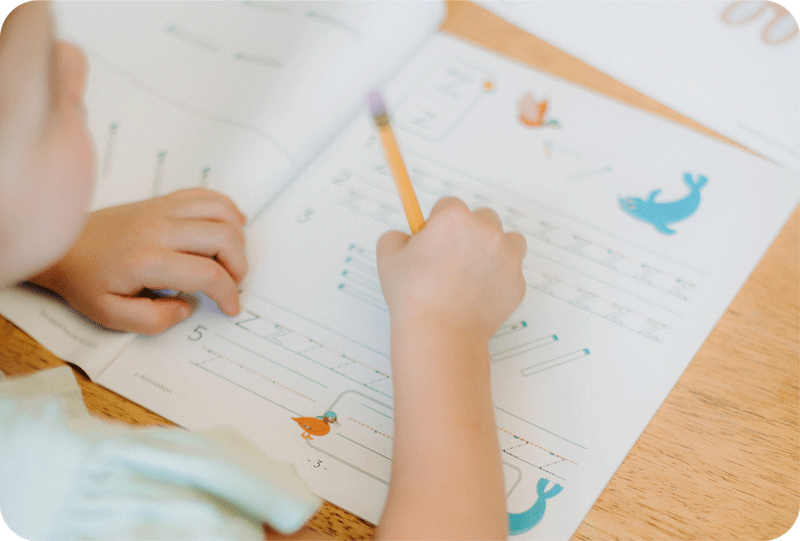
The program’s student booklets are designed for young learners—thin and manageable for small hands. Each booklet contains letters grouped by like-strokes so movements are repeated again and again. Different activities provided help with:
Each Teacher Kit contains teacher preparation material including a Teacher Practice Page to make sure the teacher understands the basic movements and components of typical handwriting learning progression.
Colorful classroom materials such as large motor skills posters, alphabet trace cards, and stroke display placards provide the teachers tools for helping kids interact successfully with their Squiggle Squad friends.
Enough time to fit all instruction in is often a concern teachers have. Many forfeit handwriting instruction because they feel they simply do not have enough time. A well-designed program should not demand long blocks of handwriting instruction. In fact, young children do not have the mental capacity to concentrate for extended durations. Well-planned, short practice times—10-15 minutes—done daily work better to build muscle memory than less-frequent handwriting marathons. Frequency and consistency with fun and encouragement is the key to student handwriting success.
A well-designed scope and sequence will help students improve steadily over time, ensuring correct technique that leads to mastery. Squiggle Squad’s scope & sequence flexibly fits into any English Language Arts program. It is designed to integrate into the literacy block in order to promote understanding and retention.
Little hands and minds develop at varying paces and teachers often need ways of meeting different needs at different times. An effective handwriting program will allow for differentiation, so all students are reached. Squiggle Squad’s incremental approach makes this easier for the teacher trying to reach several different levels of learners. The colorful resources meet the needs along the skills progression covering about three early childhood grades.
Generally speaking, handwriting programs ask 10-20 minutes of students each day. The Squiggle Squad approach sneaks practice in throughout the school day through large motor skill movements in the morning time (~5 min), to pencil practice activities (~10 min), and name writing practice in other subjects (~5-10 min). Little intentional bites of practice throughout the school day results in healthy handwriting!
All handwriting programs will include some sort of alphabet practice. Traditionally, these come in the form of workbooks. Some programs include multisensory materials like sandpaper, chalk, etc. (Science is mixed on the actual effectiveness or necessity of these for handwriting skill.) The Squiggle Squad provides a wide range of skill-building materials that help teachers guide students through large and small motor movements and booklet activities that build eye-hand coordination and, of course, introduce proper letter and number formation.
Schools expect children to be handwriting by 5 years of age, when motor dexterity and letter knowledge is still in early stages. Because of this, manuscript print is more developmentally appropriate for writing instruction. As children become familiar with proper directionality, sizing, and sitting letters on a baseline, ligatures (the connections between letters in cursive handwriting) can be added and letter formation adjusted to move into cursive writing.
Handwriting is a complex task. Copying a shape is very different than learning to write. If a child is going to build a strong writing foundation that leads to mastery, it is important that they are systematically taught. An effective methodology and well-designed resources will help your child write easily, automatically, and legibly so writing becomes more about the content and less about how it gets on the page.